The Real Cost of Web Scraping for AI Applications
Web scraping costs AI applications $500K-$6.5M+ yearly in token waste, engineering debt, legal exposure, and quality degradation. Here's the hidden financial burden founders don't realize.
TL;DR
Web scraping appears free—just server costs and a few engineers maintaining parsers. But when AI application founders calculate the true cost of web scraping, the numbers reveal a different reality:
Key Finding: For AI applications processing 100,000 conversations monthly, web scraping costs $653,380 per year in ongoing measurable expenses (Year 1: $723,380 including initial build). At 1 million conversations per month, total costs exceed $6.5 million annually.
This isn't theoretical—these are calculable costs that AI companies are paying right now without realizing it.
The Token Economics Nobody Talks About
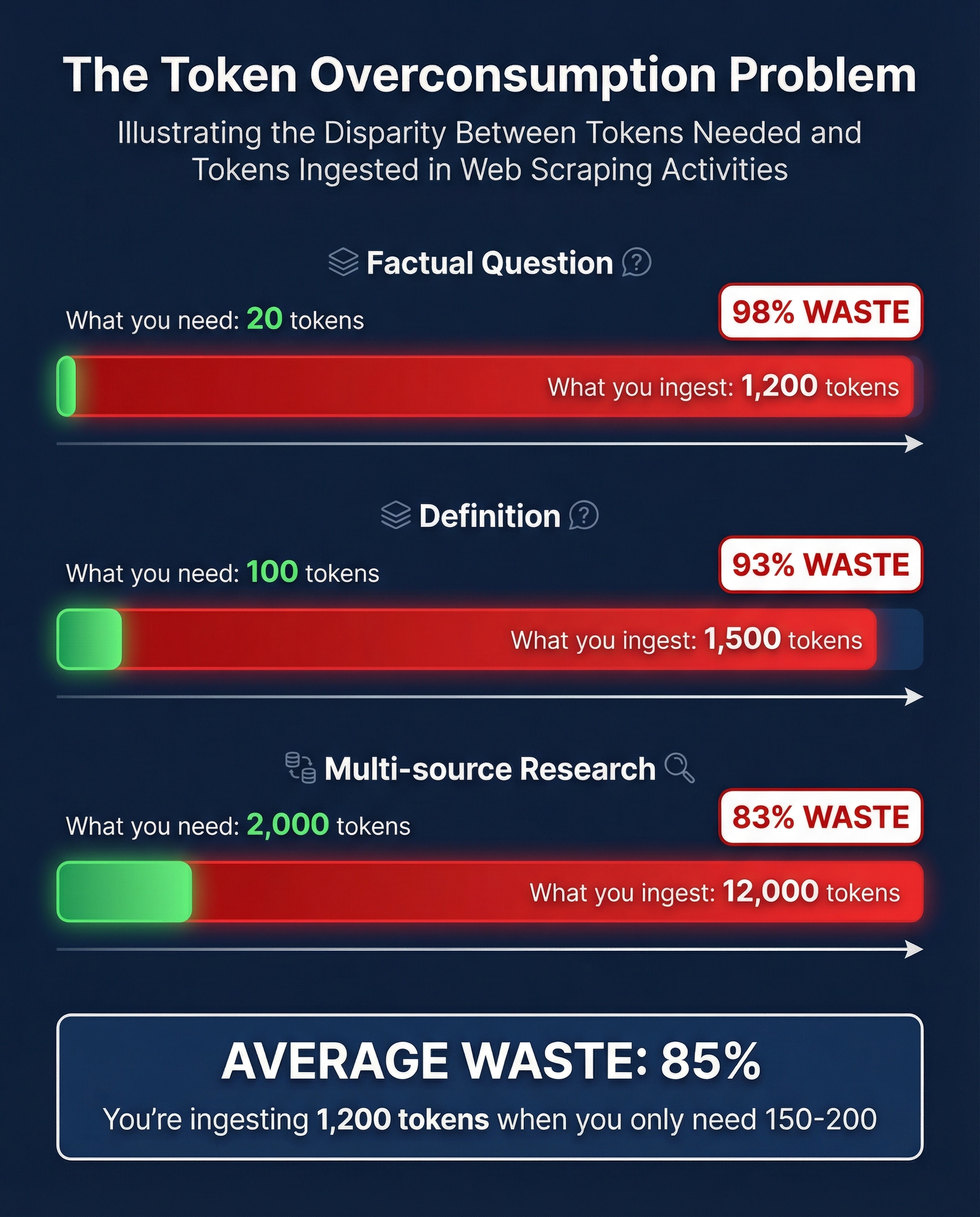
The Overconsumption Problem: What You Ingest vs. What You Actually Need
The real comparison isn't scraped vs. structured content. It's what you ingest vs. what you actually need.
When you scrape content, you're not just paying for inefficient extraction—you're paying for massive overconsumption. You ingest entire articles when you only need specific facts, definitions, or relevant excerpts.
Consider what actually happens in AI applications:
- User asks: "What is the capital of France?"
- What you need: A simple fact (~10-20 tokens: "Paris is the capital of France")
- What you ingest with scraping: Full article about Paris (~1,200 tokens)
You're paying for 1,180 tokens you'll never use.
Modern scraping tools like trafilatura and newspaper3k extract main content from HTML—but they still give you the entire article. A typical news article contains 600-900 words (~800-1,200 tokens).
The problem isn't extraction quality—it's that you're ingesting 10-100x more content than you need.
The Real Token Economics
Monthly Token Costs Comparison
Scraping full articles vs. targeted content retrieval
Current approach (scraping full articles):
- Average per retrieval: 1,200 tokens
- Monthly: 100K × 2 × 1,200 = 240M tokens = $720/month
What you actually need (relevant excerpts/facts):
- Average per retrieval: 150-200 tokens (targeted information)
- Monthly: 100K × 2 × 175 = 35M tokens = $105/month
Real waste: $615/month or $7,380/year
That's not 15-30% overhead—it's 85% waste.
Annual Token Waste at Scale
And this is just input tokens. Output tokens cost more (3-5x input pricing), and when models process massive irrelevant context, they generate longer, less precise outputs—compounding the waste further.
Engineering Costs: The True Development and Maintenance Burden
Most founders estimate 2-4 weeks to build scrapers for their target publishers. What they miss: the initial build is only 30-40% of total engineering cost. The other 60-70% is maintenance—and it never stops.
Websites change constantly. Publishers redesign sites, update HTML structure, add anti-bot measures, change URL patterns, introduce new content types. Every change breaks your scrapers.
Industry practitioners report that engineering teams spend 20-30% of their time maintaining existing scrapers rather than building new features.
Update frequency reality:
Monthly Updates Required
1-3 websites out of every 30 require code updates monthly due to structural changes
High-Security Sites
Sites with strong anti-bot solutions (Cloudflare, PerimeterX) need monthly or more frequent updates
Investigation & Fix
Each incident requires 2-3 developer days to investigate, fix, test, and deploy
The opportunity cost is staggering. Those engineering hours could build features that differentiate your product, improve core models, or optimize user experience. Instead, they're reverse-engineering HTML changes and bypassing CAPTCHAs.
Infrastructure Costs: The $20K+ Annual Overhead
Beyond engineering time, web scraping requires specialized infrastructure:
Total Infrastructure Overhead
Web Scraping Total Annual Cost
Web Scraping Cost Breakdown (100K conversations/month)
Year 1 total costs for in-house implementation
In-House Web Scraping: Annual Cost Breakdown
| Feature | Cost Category | Annual Amount |
|---|---|---|
| Token waste (overconsumption) | $7,380 | |
| Engineering development (Year 1 only) | $70,000 | |
| Engineering maintenance (25% of 3-person team) | $120,000 | |
| Infrastructure (proxies, CAPTCHAs, storage) | $20,784 | |
| Legal risk (conservative, no lawsuits) | $55,000 | |
| Opportunity cost (features not built) | $100,000 | |
| Quality degradation impact (churn, lower engagement) | $350,000 |
Third-Party Services: Annual Cost Breakdown
| Feature | Cost Category | Annual Amount |
|---|---|---|
| Service costs (Tavily, Firecrawl) | $15,000 | |
| Integration/monitoring (15% engineer time) | $24,000 | |
| Token waste | $7,380 | |
| Legal risk | $55,000 | |
| Opportunity cost | $50,000 | |
| Quality degradation | $350,000 |
Third-party services appear cheaper, but you sacrifice control and quality. Most teams start with third-party, hit limitations, and build custom anyway—paying for both in transition.
Enterprise Procurement: The Hidden Opportunity Cost
For B2B AI applications, data sourcing practices are becoming explicit RFP requirements that determine whether you win or lose enterprise deals.
Critical clause: "Customer's sole responsibility to ensure appropriate rights to all content input to AI service."
Translation: If your AI application uses unlicensed scraped content and gets your enterprise customer sued, that's on you—and you won't get the contract.
Enterprise legal compliance requirements:
- Licensing and insurance documentation
- Data protection standards (GDPR, CCPA compliance)
- IP rights and content licensing proof
- Labor law and tax documentation
"
All content released through AI services must be: Originally created by the publisher, appropriately licensed from third-party rights holders, used as permitted by rights holders, or used as otherwise permitted by law.
"
RFP evaluation criteria increasingly include:
Proof of Content Licensing
Documentation of licensing agreements with content providers
Data Sourcing Transparency
Clear disclosure of how and where content is obtained
IP Ownership Documentation
Evidence of proper intellectual property rights
Risk Management Processes
Documented procedures for managing AI output risks
If you can't prove your content is licensed, you can't win enterprise deals. The opportunity cost isn't just the lost contract—it's entire market segments you can't access.
Why Publishers Are Fighting Back
The New York Times lawsuit against OpenAI isn't just about training data—it's about ongoing operational use of scraped content threatening their business model.
NYT has spent $10.8 million in legal bills fighting this case, and it's not over.
"
If ChatGPT has already scanned articles and can summarize them instantly for free, users won't visit publisher websites, decreasing ad revenue and disincentivizing paywalled content subscriptions.
"
News Corp vs. Perplexity AI
Sued alleging the company "willfully copied copious amounts of copyrighted material without compensation." The specific concern: Perplexity "proudly states that users can 'skip the links'"—directly threatening the publisher business model.
Canadian Publishers vs. OpenAI
Alleging copyright infringement, circumvention of protective measures, breach of online terms, and unjust enrichment.
Pattern Emerges
Publishers are aggressively defending their content across multiple jurisdictions because AI scraping threatens their survival.
The Publisher Perspective of Web Scraping
The cost equation looks different from the publisher side—and understanding their economics explains why licensing models are evolving.
Publisher Revenue Crisis
Publishers are losing 30-50% of organic search traffic to AI answer engines (ChatGPT, Perplexity, Google AI Overviews). This creates a revenue death spiral:
Traffic Loss
Ad revenue declines proportionally
AI Summarization
Users don't click through to publisher sites
Affiliate Revenue Drops
Product links never seen when AI provides answers directly
Subscription Conversions Fall
Users satisfied with AI summaries don't pay for full access
Scrape-to-referral ratios (scrapes per 1 referral back to publisher):
Publishers host and produce expensive, high-quality content. AI companies scrape it hundreds or thousands of times while sending almost zero traffic back.
This isn't sustainable, and publishers know it.
The Publisher Defense Technology Arms Race
Anti-bot technology is improving rapidly, and publishers are deploying it aggressively:
28% of "most actively maintained, critical sources" have restricted AI scraping in the last year. Researchers call this an "emerging crisis" for AI companies relying on scraping.
The walls are closing in, and the cost of getting around them is rising monthly.
How AI Platforms Actually Pay for Content
The shift from scraping to licensing is accelerating—and the deals reveal what content is actually worth when AI companies can't get it for free.
Major AI Content Licensing Deals (2024)
What AI platforms actually pay for licensed content
5-year deal worth over $250 million (cash plus credits)
- Includes WSJ, Barron's, MarketWatch, NY Post
- Access to current and archived content
- Citation and attribution requirements
Market leaders are paying millions for content they previously scraped for free. This signals that:
- Legal risk is real enough to justify eight-figure deals
- Content quality matters enough to pay premium prices
- Bulk licensing is expensive but still cheaper than lawsuits and brand damage
For AI application founders, this creates a dilemma: you can't afford OpenAI-scale licensing deals, but continuing to scrape carries the same legal risks that drove OpenAI to pay $250M.
The Shift to Market-Based Pricing
Smart publishers are realizing they don't have to choose between blocking AI (and becoming invisible) or allowing free scraping (and going bankrupt).
Content marketplaces are emerging as a platform where:
- AI applications compete for access to quality content through marketplace bidding
- Publishers set minimum prices and marketplace dynamics reveal true value
- Every query is tracked and compensated—no bulk licensing guesswork
- Quality content earns premium rates through competitive demand
This shifts the economics from "negotiate bulk licensing deals worth pennies" to "discover real-time market value through transparent pricing."
For AI applications, this creates predictable, usage-based costs instead of choosing between expensive blanket licenses (if you can afford them) or risky unlicensed scraping.
The Choice Ahead
Your Options: Side-by-Side Comparison
| Feature | Approach | Reality |
|---|---|---|
| Keep Scraping | Appears free | $500K-$6.5M+/year |
| Blanket Licensing | OpenAI's approach | Millions upfront (only for well-funded players) |
| Reduce Coverage | Cut costs | Lost market share |
| Content Marketplaces | Usage-based | Emerging infrastructure |
The AI Founder's Question
The current content sourcing model is broken. Scraping appears free but costs millions. Most founders don't realize the true cost—until they do the math.
The question isn't whether AI applications need to find a better way to source content.
The question is whether you'll figure it out before your competitors do.
Ready to explore a better way?
Discover how you can get ahead of your competition with Context4GPTs—the content marketplace designed for AI applications.